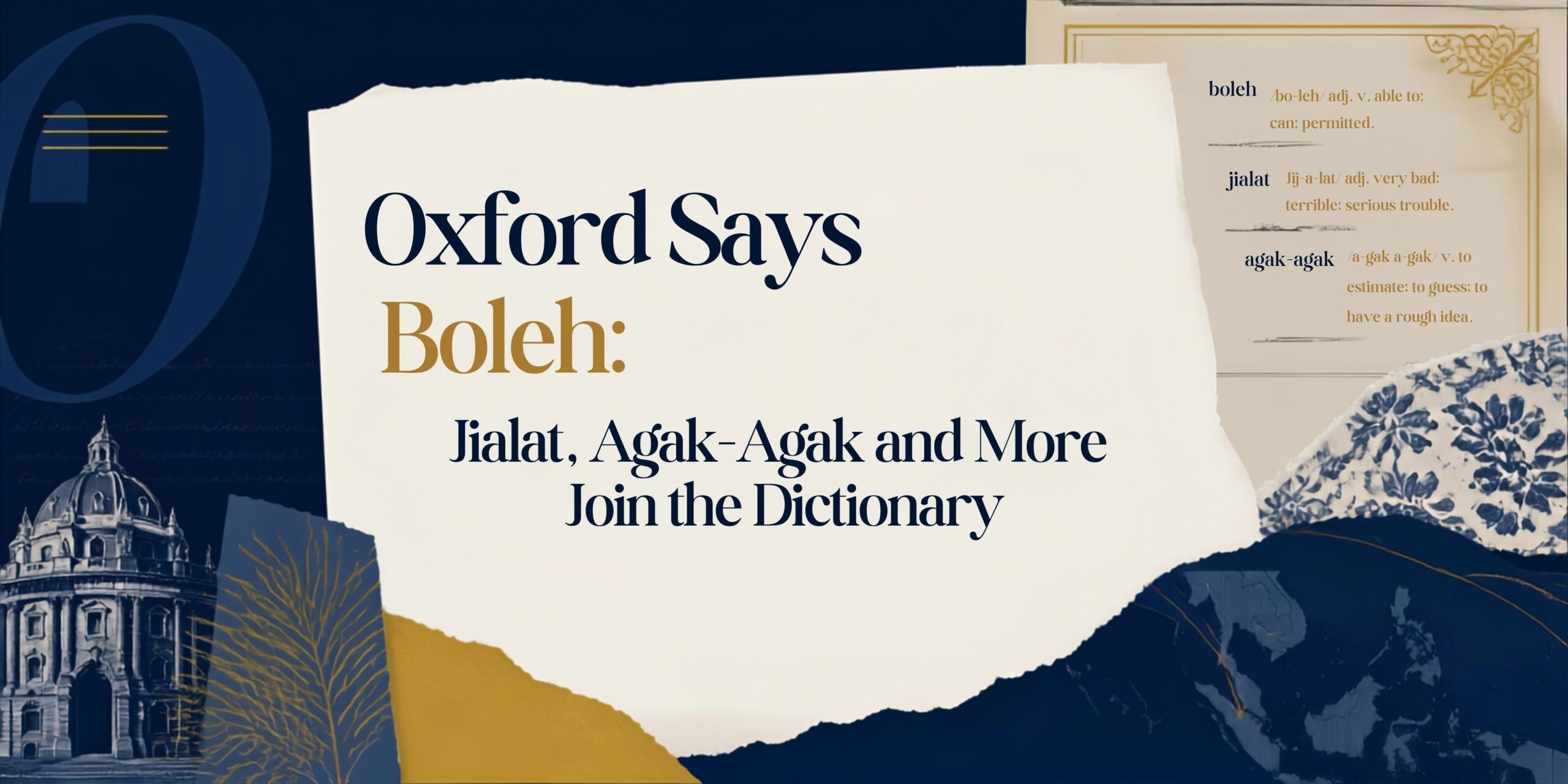
Finally, there’s international recognition to our most commonly used words!
View this post on Instagram
Here’s the full list of Manglish/Singlish words Oxford added:
- assam laksa
- agak-agak
- boleh
- BTO
- degazette
- ice kacang
- jialat
- kaypoh
- Mat Salleh
- play play
- wayang
So, what does this mean for us? When Oxford recognises words like “jialat” or “agak-agak”, it actually does not mean these words have suddenly become standard British English.
What it really means is that there is enough evidence to show that people are using them regularly as part of English, especially in places like Malaysia and Singapore.
The Oxford English Dictionary records how English is actually used. It does not simply decide which words are “correct” and which are not.
So when a word makes it into the dictionary, it usually means the word has been around for some time, appears in different sources, has a fairly consistent meaning, and is understood within a particular English-speaking community.
This is where words like “jialat” and “agak-agak” become interesting.
“Jialat”, which comes from Hokkien, is commonly used in Malaysia and Singapore to describe a situation that is bad, troublesome or serious.
For example:
“This project is really jialat.”
“Agak-agak”, which comes from Malay, is often used when estimating or making a rough guess.
For example:
“I agak-agak the cost will be around RM500.”
Both words come from other languages, but Malaysians and Singaporeans often use them naturally within English sentences.
That is really how languages grow.
English itself is full of borrowed words. Many words we now use without thinking twice came from other languages. “Bungalow”, “shampoo”, “sarong” and “amok” are just a few examples.
So Oxford recognising a word does not necessarily mean everyone in the English-speaking world will know what it means. A word can still be identified as Malaysian English, Singapore English or another regional form of English.
It also does not mean the word suddenly belongs in every type of writing.
You might use “jialat” naturally in conversation, social media or an informal article, but probably not in a formal corporate report written for an international audience.
The bigger point is that Malaysian and Singaporean English are not simply imperfect versions of British English.
They have their own vocabulary, rhythm and character, shaped by the languages people speak around them.
When words from Malay, Hokkien, Cantonese or other local languages become part of everyday English usage, they can eventually become part of the recorded language too.
So when a word like “jialat” or “agak-agak” appears in Oxford, it is less about Oxford giving the word permission to exist.
It is Oxford acknowledging that people have already been using it for years.
And sometimes, a word you hear at the mamak or kopitiam eventually ends up in one of the world’s best-known dictionaries.